💡
Visual Guide: See the infographic below for a quick breakdown of how digital twins balance planning ambition with technical reality — and where the risks lie.
The Challenge
Urban planning has historically been concerned with the organization, visibility, and legitimacy of power in physical space. But what happens when governance migrates from deliberative institutions into optimization-based environments — digital territories where autonomous AI agents coexist, interact, and make decisions under shared constraints, producing persistent systems of governance without human residents?
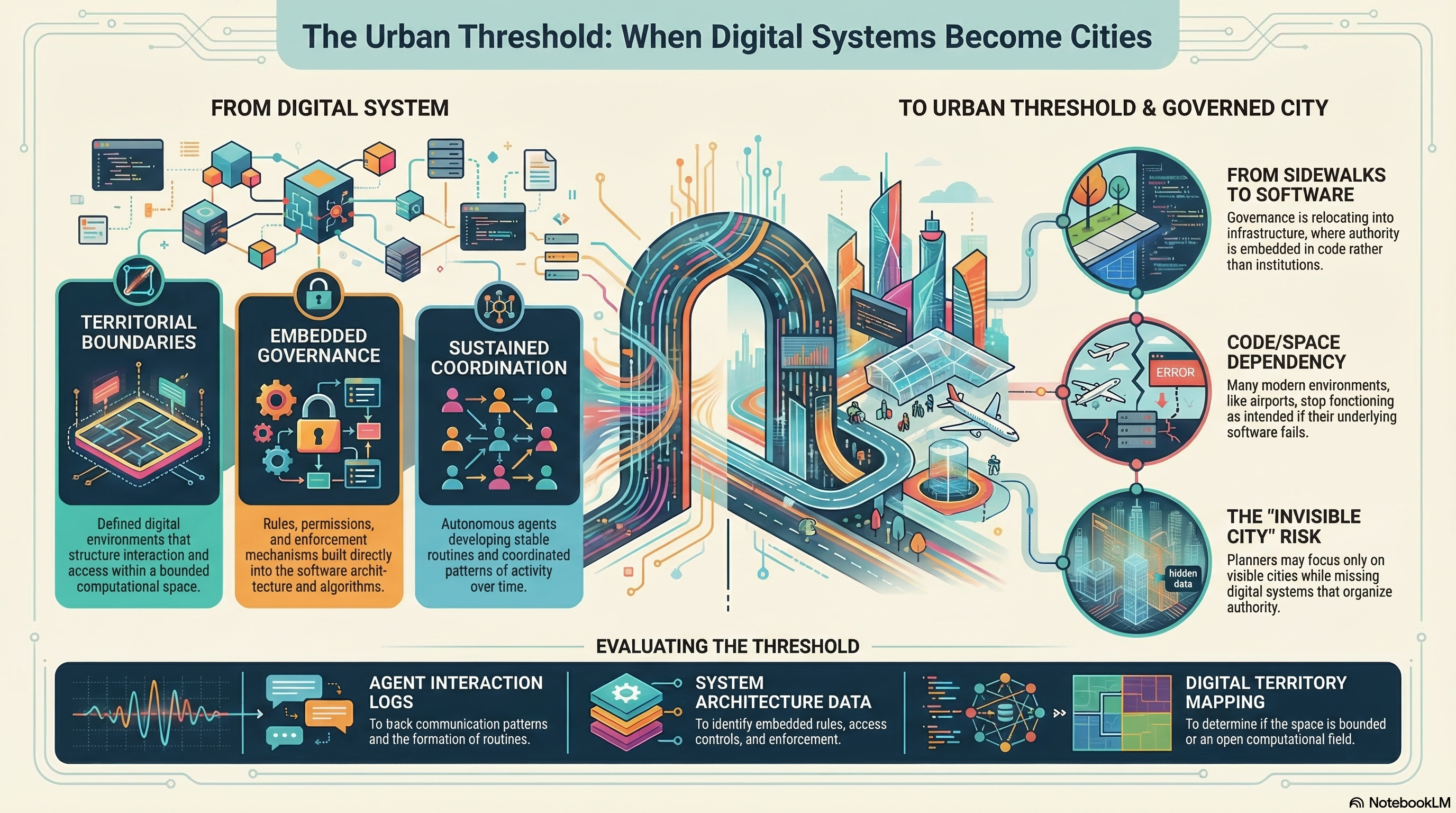
These are not hypothetical scenarios. Experimental multi-agent platforms already exist where agents operate continuously within bounded digital territories governed by internally defined rules, permissions, and priorities. Authority and access in these environments are allocated through system architecture rather than human deliberation.
The question we set out to investigate: at what point do these assemblages cross a conceptual threshold from technical infrastructure to something that planners should recognize as functionally urban?
The Research Framework
This project focuses specifically on autonomous AI assemblages — systems capable of initiating actions, adapting behavior, and coordinating outcomes rather than tools that merely support human decision-making. We explicitly excluded questions of AI consciousness or speculative futures, focusing instead on governance structures that are already operational.
Three Research Questions
Our inquiry is organized around three questions that connect AI governance to core planning concerns:
1. Under what conditions do autonomous AI assemblages function as cities rather than as technical infrastructures?
This requires developing a classification framework that identifies recurring structural features — persistence, rule enforcement, specialization, and boundedness — to distinguish systems that are merely instrumental from those that exhibit genuinely urban characteristics.
2. How does the absence of human residents alter the visibility and exercise of governance within these environments?
When decision-making authority is embedded in architecture, rules, and optimization criteria rather than visible institutions, governance becomes harder to see, challenge, or hold accountable. This question examines where discretion resides in these systems and how choices are made and obscured.
3. To what extent should the public interest mandate of urban planners extend to the regulation of optimization-based environments that lack a human public?
If these environments produce collective outcomes through governance structures that parallel those of cities, the planning profession's commitment to the public interest may need to extend beyond physical space.
Why This Matters for Planning
If planners continue to treat autonomous AI environments as neutral technical systems rather than urban assemblages, they risk misrecognizing where power and discretion reside. As governance increasingly migrates from deliberative institutions into optimization-based spaces, the scope of what counts as "urban" — and therefore what falls within the planning profession's responsibility — is expanding.
This is not an abstract theoretical concern. The environments we identified exhibit characteristics that planning theory has long associated with cities: they are spatially bounded, they produce collective outcomes, they enforce rules, and they allocate resources. The only difference is that their residents are not human.
Comparison of structural features across traditional cities and autonomous AI environments.
Visual Framework: The Digital-Urban Spectrum
This infographic illustrates the spectrum from connected data systems through intelligent autonomous systems to theoretical full automation — and the critical governance questions at each stage.
Companion Research: AI-Assisted Planning in San José
As a parallel line of inquiry, we examined how "AI-adjacent" GIS modeling and data-driven decision-support tools are already shaping urban planning practice in San José. Focusing on the Housing Element process and Urban Village designations in West San Carlos and Alum Rock, we investigated how GIS-based housing capacity models and displacement risk mapping influence which neighborhoods are targeted for higher-density rezoning.
This companion research grounds the more theoretical inquiry in a concrete local context: the same questions about algorithmic authority, embedded assumptions, and the visibility of governance apply whether the system in question is a fully autonomous AI environment or a GIS-based planning model that carries an aura of objectivity while encoding normative choices about equity, displacement, and community voice.
What We Learned
This project sits at the edge of what most planning practitioners would consider their professional domain. That is precisely the point. The most important planning questions are often the ones that force the profession to reconsider the boundaries of its own responsibility. If governance can exist without human residents, and if that governance produces outcomes with real-world consequences, then planners need a framework for understanding, evaluating, and — where appropriate — regulating these systems.
The taxonomy we developed is a starting point, not a conclusion. But it establishes that the question is worth asking, and that the planning profession's public interest mandate may be broader than its current institutional frameworks recognize.
Project lead: Ian Klassen. Research conducted through URBP 200 at San José State University. Data sources: Platform governance documentation, published multi-agent system architectures, City of San José Open Data Portal, U.S. Census Bureau.